Strategy
How to Enforce Prices Without Accidentally Buying the Player
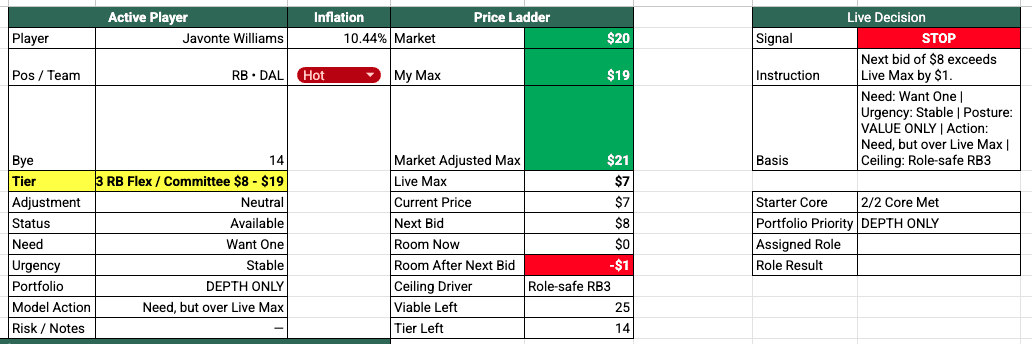
You've seen it happen.
A player you don't particularly want is going for $24.
You think he's clearly worth more than that.
Another manager bids $25.
Surely somebody should make them pay more.
So you bid $26.
Silence.
Sold to you for $26.
Congratulations. You successfully enforced the price.
On yourself.
Price enforcement is tempting because it feels like free money. If another manager is getting a bargain, why not make them spend another dollar or two?
Sometimes that's exactly the right move.
Sometimes it's how you end up with a player you never intended to draft.
The difference comes down to one rule:
Never make a price-enforcement bid unless you're genuinely willing to own the player at that price.
What Is Price Enforcement?
Price enforcement is bidding primarily because you believe the current price is too low—not because the player was one of your original targets.
Suppose a wide receiver has:
Market Value: $31
Current bid: $24
Another manager is about to get him for $24, so you bid $25.
If they bid $26, you've forced an opponent to spend another dollar.
If someone else jumps in, you've pushed the sale closer to what the market suggests the player should cost.
And every extra dollar an opponent spends is a dollar they can't use against you later.
But there's a catch:
You cannot enforce a price without accepting the possibility that your bid wins.
There is no “just kidding” button.
The Best Enforcement Bid Is Also a Value Bid
A good price-enforcement bid should have two acceptable outcomes.
Someone else keeps bidding.
Good. They spend more.
Nobody keeps bidding.
Also good. You bought the player at a price you're comfortable paying.
If only the first outcome makes you happy, you're not really making a value bid.
You're bluffing in a game where the other managers can simply let you win.
That's why the right question isn't:
“Should somebody make them pay more?”
It's:
“Would I be happy owning this player if my next bid ends the auction?”
If the answer is no, don't bid.
“I Didn't Target Him” Doesn't Mean “I Don't Want Him”
There are plenty of players you may not want at their expected price but would gladly take at a discount.
Maybe another wide receiver wasn't part of your ideal roster construction.
But if a player expected to cost around $30 is sitting at $22, your plan may be flexible enough to take advantage.
That's not abandoning your strategy.
That's recognizing value.
The safest price-enforcement candidates are players who fit this description:
Not a target at the expected price. Absolutely acceptable at the current price.
If the other manager keeps bidding, fine.
If the auction stops, you bought value.
Let Your Live Max Set the Boundary
Price enforcement does not create a separate set of bidding rules.
Your maximum still matters.
Suppose Auction Command Center shows:
Market Value: $29
My Max: $31
Market Adjusted Max: $33
Live Max: $30
The room may be inflated enough to justify $33 in a vacuum, but your current roster and budget say $30 is the most you should actually spend.
If bidding is at $26, an enforcement bid may make plenty of sense.
At $30, you've reached the line.
At $31, you're no longer enforcing the price intelligently. You're exceeding the number your current draft situation supports because you're hoping somebody else saves you.
That's exactly the kind of decision Live Max is designed to simplify.
Our guide to setting your maximum bid in a fantasy football auction goes deeper into how those bidding limits develop.
When Price Enforcement Makes Sense
Price enforcement is strongest when three things are true.
The Price Is Clearly Below Your Maximum
If your Live Max is $32 and bidding is sitting at $24, you have substantial room.
You may not have planned to buy the player, but winning at $25 would still be a defensible outcome.
The closer bidding gets to Live Max, the less room you have to play traffic cop.
The Player Still Fits Your Roster
An underpriced player can still be the wrong purchase.
If you already have three running backs and desperately need wide receivers, another cheap running back carries a real opportunity cost.
Auction Command Center's live bidding guidance reflects more than the player's standalone price. As your roster and available budget change, so does the amount you should be willing to commit.
That's important for price enforcement because a bargain only matters if you can use it.
The Opponent's Savings Could Matter Later
Letting another manager get one cheap player isn't a crisis.
But repeated bargains can create a competitor with both a strong roster and extra purchasing power.
That's where tracking remaining team budgets and roster needs becomes useful.
If an opponent saves $6 here, that $6 may become bidding power against you later.
Conversely, if the manager you're trying to pressure is already near the limit of what they can spend, your next “harmless” enforcement bid may simply become the winning bid.
Knowing what the other teams can still afford makes price enforcement much less speculative.
[ACC LEARN MORE CTA]
When You Should Stay Out
There are also some easy warning signs.
You Would Be Unhappy If You Won
This overrides everything else.
If the thought of actually rostering the player bothers you, don't bid.
Never rely on:
“There's no way he lets me have him for this.”
Maybe he will.
Make every bid assuming the auction could end immediately.
You're Already at Your Maximum
If Live Max is $27 and another manager bids $28, the enforcement opportunity is over.
The fact that $28 is only one more dollar doesn't change your limit.
Let them have the player.
You're Trying to Punish Somebody
Maybe another manager stole one of your targets.
Maybe they're having a great draft.
Maybe you're simply annoyed they're getting another discount.
None of those are reasons to spend your budget.
Price enforcement should improve your position—not satisfy your ego.
Watch Inflation Before Calling Something a Bargain
A player selling below preseason expectations does not automatically mean someone is stealing him.
Your room may simply be deflated at that position.
That's why Market Adjusted Max matters.
Auction Command Center adjusts your strategy-based maximum for the inflation or deflation developing in the room. That gives you a better reference point than comparing every live bid with a static preseason number.
If the auction is consistently running cheap, a price that initially looks like a bargain may actually be close to the room's new normal.
Our guide to fantasy football auction inflation explains that adjustment in more detail.
Be More Careful Late in the Auction
Price enforcement gets riskier as the draft progresses.
Early on, several managers may have the money and roster flexibility to keep bidding.
Later:
Rosters fill.
Budgets shrink.
Maximum bids fall.
Fewer teams can legally or sensibly bid.
A player worth $7 sitting at $3 may look like an obvious enforcement opportunity.
But if only one other manager can afford $4, your bid may end the auction.
This is another place where tracking every team's remaining money and roster situation gives you information that intuition alone can't.
You Don't Have to Enforce Every Bargain
You will watch other managers get good deals.
That's okay.
Your job is not to make every player sell at fair value.
You have a finite budget, finite roster spots, and your own opportunities to pursue.
Sometimes the correct decision is to let another manager get a bargain because competing would interfere with something more valuable to your team.
Auction discipline isn't making sure nobody else ever wins.
It's knowing which battles actually matter.
The Three-Question Price-Enforcement Test
Before making a bid primarily to push somebody else's price, ask:
1. Is this bid at or below my Live Max?
If not, stop.
2. Does this player still make sense for my roster and budget?
If not, stop.
3. If everyone else goes silent right now, am I happy owning him at this price?
If not, definitely stop.
If all three answers are yes, the bid is defensible.
If someone else keeps bidding, you've made them spend more.
If they don't, you've acquired a player at a price you were willing to accept.
That's smart price enforcement.
Don't Bluff With Money You Can't Take Back
Price enforcement isn't really about pretending you want a player.
It's about recognizing that the current price is attractive enough that you're willing to become the buyer.
That distinction keeps the tactic disciplined.
Use Market Adjusted Max to understand what the room's pricing environment supports.
Use Live Max to know what your current draft situation supports.
Watch opponent budgets so you understand whether someone can realistically keep bidding.
And then make every bid with the expectation that it could be the last one.
Because eventually, one will be.
And when it is, you want to be happy with what you bought.